

If you have a heart condition you may need to have a procedure to correct it, or have a device implanted.
Here is information regarding the various procedures and devices you might be treated with.
ANGIOGRAM
A coronary angiogram is a procedure performed with the guidance of X-ray, to determine if your heart’s arteries and valves are narrowed or blocked.
The angiogram is performed in a cardiac catheter laboratory by a cardiologist, specialised nurses and technicians. It takes about 30 to 40 minutes. Patients need to be awake during the procedure, so they can follow the doctor’s instructions.
This procedure may also be done in an emergency, such as during an episode of angina or a heart attack.
Preparation
- You will be asked not to drink or eat for some hours beforehand.
- The nurse will place a drip in your arm to administer fluid.
- You may be given a sedative to help you relax.
- To relieve any discomfort when the catheter sheath is inserted, you will receive a local anaesthetic in the area (groin or arm).
- Once the catheter is in place, a small amount of x-ray dye is injected through it into the arteries, and x-ray pictures are taken with a camera. You may be asked at this point to hold your breath.
- When the doctor is examining the ‘pumping chamber’ of your heart, you may experience a warm sensation in the upper chest, spreading over the body. This shouldn’t last more than about 10–15 seconds.
Helpful video to prepare you for your Angiogram
Heart Research Australia, in association with Royal North Shore Hospital and North Shore Private Hospital, has created the video below to provide information about coronary heart disease, the angiography procedure and a personal insight into life after a heart attack.
Click the arrow below to view the video.
After the Angiogram
The catheter is removed and pressure is applied to the area where it was inserted. When you return to the ward you will have to lie flat for four hours. This is important as it prevents unnecessary bleeding from the puncture area. The nursing staff will routinely check your blood pressure, pulse and groin/arm area. You can expect to return home that afternoon or the next morning.
STENTS
A coronary stent is a small piece of stainless steel mesh that is inserted into a coronary artery after angioplasty.
What does a stent do?
The stent holds the coronary artery open. The aim is to:
- improve blood flow to the heart muscle
- relieve the symptoms of coronary artery disease
- reduce the chance of the blockage returning.
The procedure may be done in an emergency, such as during an episode of angina or a heart attack. There are many different types of stents. Your cardiologist will decide which is best for your heart.
Procedure
The procedure is performed by a cardiologist, specialist nurses and technicians, and normally takes between 45 and 90 minutes. You will be asked not to eat or drink for six hours before the procedure.
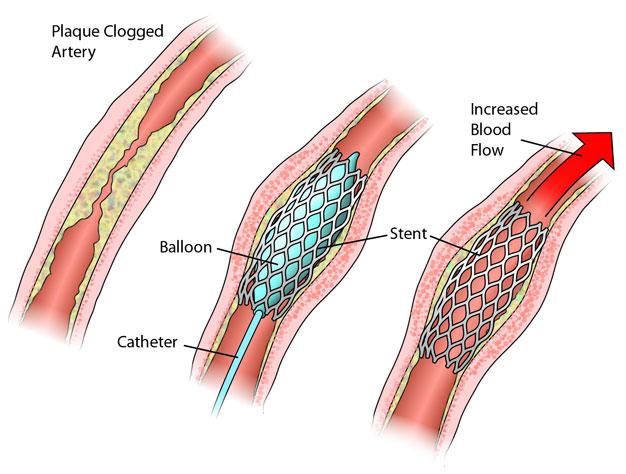
A stent procedure is very similar to that of an angioplasty. A balloon-tipped catheter is passed through a sheath and into the coronary artery at the site of the narrowing or blockage. The catheter is then inflated, compressing the narrowing or blockage, and opening the artery. This improves blood flow to the heart.
You may feel some pressure when the balloon is inflated. This is normal and will go away quickly.
The catheter is then removed. The stent, mounted on the end of another balloon catheter, is moved up and positioned in the coronary artery, at the site of narrowing or blockage.
The catheter is inflated, causing the stent to expand and be implanted in the vessel. The balloon catheter is then deflated and removed. Sometimes more than one stent is placed in the artery. You can be reassured that your stent cannot move or be dislodged.
During the procedure you will be given a blood-thinning agent.
After the procedure
After the procedure, the sheath will be left in your groin or arm until the blood-thinning agent has worn off. This usually takes several hours.
It is important to keep the leg with the sheath flat for four hours and remain in bed for at least 12 hours (or longer for people on anti-clotting medicines). If the stent was inserted via the radial artery in your arm, you should remain in bed for two hours.
The nurse will remove the sheath and apply pressure to the site until it stops bleeding, generally within about 20 minutes.
You are usually in hospital for one or two days. However, it could be longer if you have started anti-clotting medications.
Medication
When you go home, your medications will include:
- aspirin
- clopidogrel
- warfarin (sometimes).
These all prevent blood clots from sticking to the surface of the stent and causing a blockage. It is very important that you follow the medication regime.
Do not stop taking any of the prescribed medications unless instructed to do so by the cardiologist who implanted the stent.
ANGIOPLASTY (balloon catheter)
Angioplasty is a procedure for widening a narrowed coronary artery.
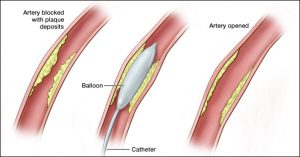
It is also known as PTCA (percutaneous transluminal coronary angioplasty). The surgeon inflates a balloon-tipped catheter to open a blocked artery at the point where it has narrowed. This allows greater blood flow through the artery.
The procedure may take about 60 minutes.
 Procedure
The first part of an angioplasty is similar to the angiogram you may have already had.
The catheter is passed through a sheath and placed across the site of narrowing in the artery. It is then inflated one or more times until the artery is opened wide enough.
This may cause some discomfort and you may be asked to rate your discomfort on a scale of 1–10. If necessary you will be given medication.
It is important to tell the staff if you experience any discomfort or chest pain throughout the procedure.
After the procedure
Your care after the angioplasty is very similar to the care you will receive after an angiogram. However, the sheath may be left in your groin for several hours in case the artery begins to close and the procedure needs to be repeated.
When you return to the ward, nursing staff will make you comfortable, take observations and monitor your heart rate. If you have pain or discomfort after the procedure it is important to ring for a nurse.
Patients are not allowed to eat or drink until their condition is stable and they are advised by the nurse.
You will remain on bed rest for several hours, keeping your leg with the sheath flat, and then for another four hours after the sheath is removed. Usually you can go home after one or two days.
DEFIBRILLATORS (ICD)
ICD stands for implantable cardioverter defibrillator. This is a small electrical device which, rather like a pacemaker, is put into the body to detect and treat life-threatening abnormal heart rhythms.
But whereas the pacemaker is primarily designed to treat slow heart rhythms and atrial fibrillation, the ICD corrects heart rates that are fast (ventricular tachycardia and ventricular fibrillation) or slow. These are rhythms that originate in the lower chambers of the heart: ventricular tachycardia (VT) and ventricular fibrillation (VF).
What does an ICD do?
The ICD
- monitors the heart’s rhythm
- senses and detects rapid or slow heart rhythms
- treats abnormal rhythms with electrical therapy
- stores data for review.
Its actions include:
- bradycardia pacing – low-energy electrical pulses when the heart rate is too slow
- anti-tachycardia pacing (ATP) – a series of small, rapid electrical pulses to interrupt a rapid, abnormal heart rate and return the heart to its normal rhythm
- cardioversion – a shock impulse to correct VT
- defibrillation – a stronger shock impulse to correct VF. This has been described as feeling like a kick in the chest.
ELECTROPHYSIOLOGICAL STUDY (EPS)
An electrophysiological study is used to diagnose and treat cardiac rhythm disturbances.
Using special pacing wires, the doctor can identify your rhythm disturbance and choose the best method of treatment.
The procedure usually takes 1 to 1½ hours. It is performed in a special laboratory under local anaesthetic, so you will be awake and able to communicate with the doctor and staff. You may be given medication through the cannula to help you relax.
You will be attached to an ECG monitor by the cardiac technician or nurse, who both assist the cardiologist throughout the procedure.
The doctor will be dressed in theatre garments, and will clean the groin area with antiseptic, and cover you with green sterile drapes. The doctor will then inject a local anaesthetic into your groin. This may cause a brief stinging sensation as the area goes numb, but once the medication has taken effect you should not feel any discomfort.
The catheters or pacing wires are introduced through the groin into the leg vein and guided. With the use of an x-ray camera above the bed the wires are placed into the correct position in your heart. You will have no sensation of this, as there are no nerve endings in the blood vessels.
Between one and four pacing electrodes are placed in different positions in the heart. The doctor will give small electrical impulses through the electrodes, which will cause your heart to beat at different rates. You may feel your heart beat very quickly, or experience ‘skipped beats’. This is part of the test and you should not be alarmed. However, let the staff know if you feel any discomfort or chest pain.
It is possible during the test for the doctor to initiate a rapid heart rhythm. It is very important that the doctor knows how you feel at this time. You may be asked questions such as:
- Do you feel dizzy or lightheaded?
- Do you feel your heart pounding?
- Is this similar to the feeling you had before?
During the test the doctor may administer medication to control your heart rhythm. The doctor will monitor how effective this medication is for you. This will be given through the cannula.
In some cases a rapid heart rhythm may cause you to pass out for an extremely short period of time. A small electric shock may be required to restore your normal rhythm. Although it may be frightening to think of this possibility, most patients do not report experiencing any pain. Some people do not even recall passing out.
When the EPS is completed, the doctor will remove the catheters and apply pressure to the insertion site for 5–10 minutes to prevent bleeding. A small sterile dressing will be applied, which may be removed after 24–48 hours. No stitches are required. The results of your EPS will be explained to you by your doctor.
After the EPS
You will be returned to your ward where you will need to rest in bed for about two hours. A nurse will monitor your pulse and blood pressure, and observe the groin for signs of bleeding. You will be able to eat and drink.
If your doctor prescribes medication for your heart rhythm disturbance, it is important for him to make sure it is working correctly. You may need to have a follow-up study after a period of time on medication; this test is similar but usually a much shorter procedure.
PACEMAKERS
A cardiac pacemaker is an electronic device designed to monitor the heart’s rhythm, and deliver a pulse to the heart at a programmed rate. This will assist your heart to maintain a healthy rhythm when your own heart rate is too slow or irregular. Pacemakers are mainly used to treat slow heart rhythms and atrial fibrillation.
 How do they work?
A pacemaker consists of two main parts:
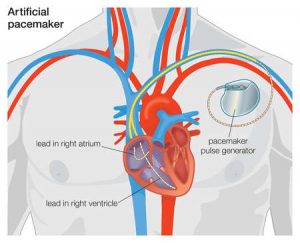
The pulse generator, which produces the pacing pulses. It is powered by a small, sealed battery. The battery cannot be re-charged and the pulse generator must be replaced when the energy levels are depleted.
The lead or leads, which deliver the pacing impulses to the heart and monitor you heart’s activity, relaying this information back to the pacemaker. The pacing wire (lead) is a narrow insulated conducting wire generally placed in the right atrium, the right ventricle or both.
Implanting a pacemaker
Putting in a pacemaker is a relatively short procedure (normally less than an hour). It can be done under a local or general anaesthetic, depending on the need.
The pacemaker lead is carefully inserted through a vein into your heart, using x-ray monitoring to ensure correct placement of the lead. The pacemaker is implanted just under the skin below the collar bone. The device and lead are checked before closure.
RADIOFREQUENCY ABLATION
Radiofrequency ablation is a procedure to cure rapid heart rhythms (tachycardia) in the heart. Abnormal electrical pathways in the heart (short circuits) are usually the cause.
This procedure is very similar to an electrophysiological study (EPS), which is performed beforehand.
The Procedure
The doctor inserts three or more temporary pacing wires, normally through your groin into a vein.
Each wire is guided to the heart under x-ray control and positioned at the required site. Once in position, each wire is connected to the monitoring equipment.
You will undergo a repeat of the EPS to map the characteristics of your heart’s electrical conduction system. Having gathered the information the doctor will trigger the tachycardia (rapid heart beat). By doing this, the exact site of the accessory pathway (short-circuit) will be established.
Once the site is isolated, high-frequency energy is applied to the tip of the electrode of the wire positioned at the site of the accessory pathway (origin of the short-circuit). Radiofrequency ablation is then used to cauterise the accessory pathway (short-circuit). It may often be necessary to reposition the pacing wire several times to eliminate the short-circuit successfully.
If it appears that the ablation was successful, the doctor will wait a prescribed time before attempting to trigger the tachycardia again. If it restarts, the doctor will reposition the wire once more and deliver further radiofrequency energy to ablate the pathway. This process is repeated until the short-circuit has been ablated. The procedure is successful when the tachycardia is unable to be re-started.
Sometimes the pathway is not accessible for this procedure because it is too deep, or lies on the outside of the heart. The doctor will then consider other options for management of your tachycardia.